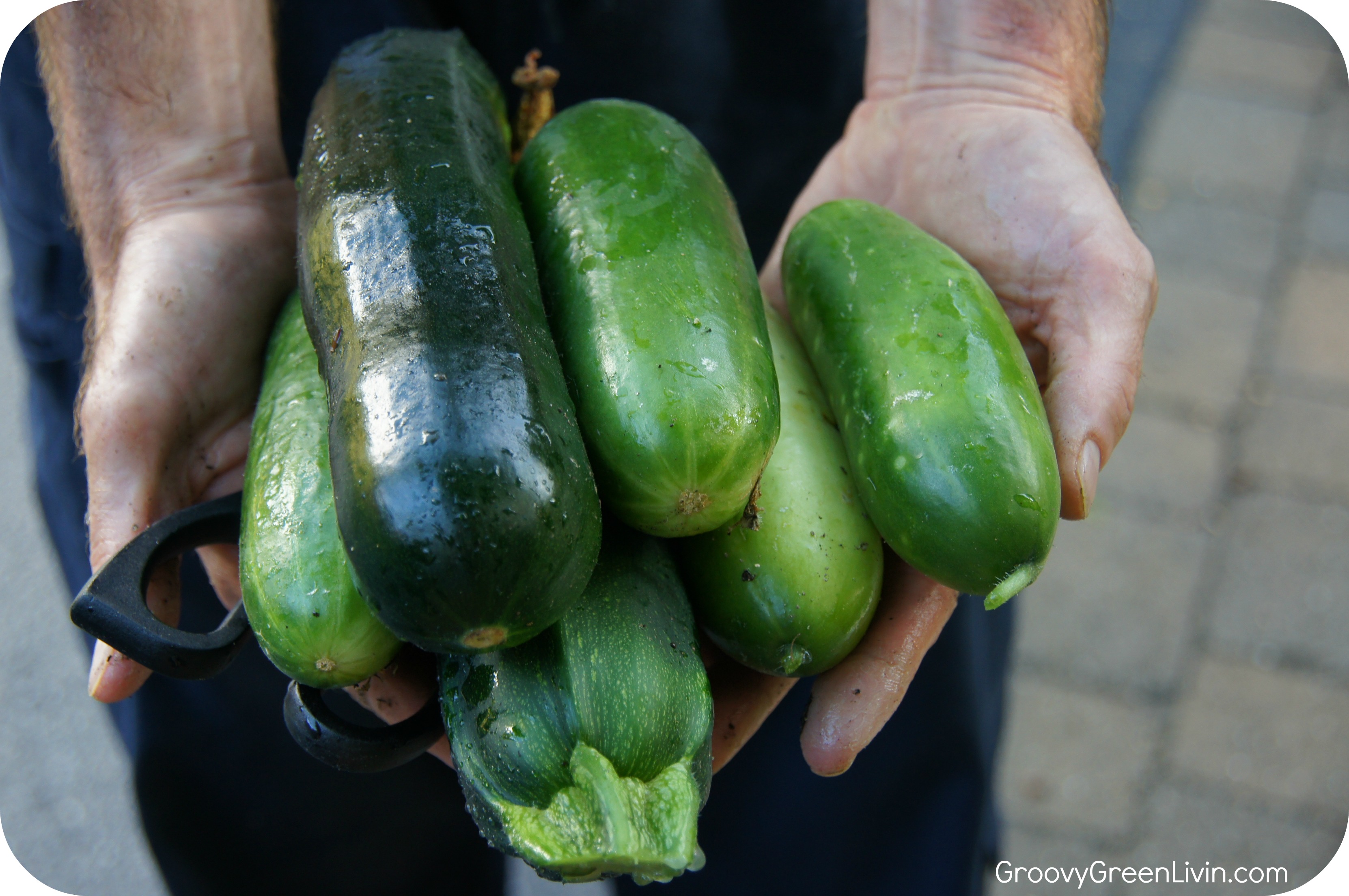
It’s Wednesday and all over the internet you will find photos with no words of explanation. Why? Because pictures say a thousand words and today is Wordless Wednesday.
I’ve been writing a lot about our small, itty bitty organic garden. I can’t stop writing and sharing photos because I’m in shock that we actually got our act together this year and planted. I’m also amazed that the garden is thriving (it looks like a jungle out there). Here’s what we picked this week. Impressed? I am.
The combination of heat and humidity have been draining over the past few days. To keep everyone cool and happy we have ramped our smoothie addiction up a notch. We are now experimenting with different flavors of sorbet, which are just as easy to make (if not easier) than a smoothie. This week we tested out a few different flavors and voted on our favorite. The Vegan Strawberry Sorbet was the winner.
The key ingredient in this sorbet are a few frozen bananas. As our bananas ripen and begin to turn brown I put them in the freezer so they’re ready for use.
Ingredients
A few frozen bananas ( one banana for each 12 oz. bag of frozen strawberries)
Lately I’ve been receiving oodles of amazing green questions from Groovy Green Livin readers through Facebook, Twitter and email. I love that so many of you are reaching out. While I try to answer each and every question individually, there are times when it’s impossible. There are also many times when your fabulous questions deserve to be shared. So in light of all of the above, I’ve decided to create a weekly post dedicated to your questions!
This weeks question comes from a longtime groovy green friend and was raised during our monthly book club.
Baking soda is touted as an all natural cleaner and we use it for so many things, but I have no idea what it is and where it comes from. Can you help?
What is baking soda?
Baking soda is pure sodium bicarbonate. In its natural form, baking soda is called nahcolite, taking its name from its chemical formula.
It is a naturally-occurring mineral that is chemically known as sodium sesquicarbonate. Trona is the raw material which is refined into soda ash. Soda ash, in turn, is used to make glass, paper products, laundry detergents, and many other products. It also is used in the manufacturing of other chemicals, such as sodium bicarbonate (baking soda) and sodium phosphates (detergents).
Baking soda is considered very safe and non-toxic. So many foods contain baking soda. I use it to bake with constantly. It doesn’t taste very good straight up, but you technically could take a teaspoon of baking soda and eat it.
Any environmental issues with baking soda?
My friend Umbra over at Grist raises an interesting environmental issue with regard trona mining:
“…the wastewater is very salty, and when it is piped away to a holding pond, it can make the birds that visit said pond fall sick, and sometimes drown.”
What’s the difference between baking soda and baking powder?
Baking powder contains sodium bicarbonate (the only ingredient in baking soda), but it includes the acidifying agent already (cream of tarter), and also a drying agent (usually starch). You can substitute baking powder for baking soda, but you can’t use baking soda in place of baking powder.
Baking soda uses
There are so many amazing uses for baking soda. I use it for everything from baking to cleaning. Think outside of the cookie box and the baking soda options are endless. Here are a few great resources to help find ways to use baking soda that may not have crossed your mind.
Now I need some help from you: I would like to name my weekly Q & A post with a catchy title-something like Dear Groovy Green Livin (but much more creative!). Let me know if you have any ideas! Also, send your groovy green questions to me and you could be featured as next weeks question of the week!
[Photo used under Creative Commons from Deb Nystrom/Flickr]
On April 22, 2012 more than one billion people around the globe will participate in Earth Day 2012. Earth Day is a day earmarked for action; a chance to show how important the environment is to you. The message of Earth Day can expand far beyond this one day-it can be a theme carried over into our everyday actions and efforts.
In celebration of Earth Day Cascadian Farm sent me an Earth Day Celebration Kit. It arrived in an awesome picnic basket and included Cascadian Farm products, VIP coupons for free products and recipe ideas, along with an extra kit for a giveaway to one lucky reader of Groovy Green Livin!
Organic feast
It’s baseball season for two of my sons, which translates to being out on a baseball field most nights of the week. Trying to squeeze in a decent meal is somewhat tricky, but with a little planning we are able to stick with our healthy eating habits. In keeping with the tradition of celebrating Earth Day every day, we decided to pick a random night and prepare an organic feast together.
My kids love to cook, so it was relatively easy to get them involved in the process. I’ve learned over the years that when they help out they are more likely to eat the final product. We picked out a few recipes from the recipe booklet that was sent along in the kit. Each recipe used some of the great products from Cascadian Farm.
Buying organic is always the better option. Organic food is free of pesticides and other toxins commonly found in conventional products. It’s not always possible and can be cost prohibitive, but we try to buy organic as much as possible. It’s also important to remember that organic doesn’t always mean healthy. It’s important to read the ingredients in every product, organic or conventional.
We started off with roasted vegetable pizza
Added Spa Smoothies for dessert
If you want to join in the fun and create your own organic feast in celebration of Earth day hop on over to the Cascadian Farm Facebook page. You’ll find great recipes, including the pizza and smoothie recipes used in our feast.
GIVEAWAY
Now’s your chance to try out Cascadian Farm products! One lucky Groovy Green Livin reader will receive their very own picnic basket from Cascadian Farm filled with all sorts of goodies (Value $60!).
The giveaway is now over. Congratulations to Christopher S. and thank you to all who entered!
For another opportunity to win this kit, Tiffany at Nature Moms is also giving one away. Check that out HERE.
Disclosure: Thank you to Cascadian Farm for a complimentary picnic basket filled with products and coupons in celebration of Earth Day. The opinions expressed in this post are my own.
The first time I tried tempeh I wasn’t a fan. I didn’t like the texture or the taste. A few years have passed and I can honestly say I’ve come full circle. Tempeh has become a food I can’t live without.
What is tempeh?
Tempeh is relatively new to those of us in the west, but it’s been a staple for hundreds of years for many living in Asia. Tempeh is made from cooked and slightly fermented soybeans and formed into a rectangular patty. The consistency is similar to that of a veggie burger. Many use it as a meat substitute in dishes. It has a nutty, grainy flavor.
Soy products have gotten a bad rap over the past few years and fallen victim to controversy. Fermented soy products, such as tempeh and miso, have been touted as healthier soy selections. As with any food, all soy products should be eaten in moderation.
Health benefits of tempeh
Tempeh is an excellent source of protein and fiber. It also is high in nutrients like manganese and copper. The fermentation process makes the soybeans soft and easy to digest. Tempeh also acts as a natural antibiotic.
Cooking with tempeh
There are generally two types of tempeh out there: fresh and vacuum-sealed. Both are found in the refrigerated section of your store. Tempeh is fairly simple to cook with. Here are few suggestions for incorporating tempeh into your diet.
Stir fried tempeh
I add tempeh to stir fry on a regular basis. It’s a great meat substitute and soaks up the flavor of any sauce or seasoning used.
Tempeh is generally sold in blocks or bricks. Cube the block of tempeh into 1 inch pieces. I use Bragg’s liquid amino in my stir fry’s instead of soy sauce or tamari (Japanese soy sauce). Stir fry the tempeh in a little olive oil and some Braggs. The tempeh will turn slightly brown. Add tempeh to any stir fry in place of tofu, chicken or shrimp.
Baked tempeh
Tempeh on its own, without any sauce or seasoning, doesn’t have a lot of flavor. If you plan to bake it I would suggest marinating the tempeh overnight in your favorite sauce. After marinating, pop it in the oven for 20-30 minutes on 350 degrees and you will have a great dish. Another idea: dice up the baked tempeh and add to stir-fry!
Every week I’m amazed by the variety of headlines that pass by my desk. This week was no different. Here are a few headlines that caught my attention:
There was a lot of buzz surrounding opening day of The Lorax movie. The movie opens today-Happy Birthday Dr. Seuss!
There was also great information on how to avoid artificial flavors in your food.
We found out that Walmart will be selling Monsanto GMO corn starting this summer.
My friend Anna over at Green Talk started a petition asking the FDA and the EU to institute strict guidelines regarding arsenic in rice. Please take a few seconds to sign Anna’s petition.
The beauty of Julianne Moore’s gorgeous clean air gardens (which happen to be right in New York City) helped to ground me and put some perspective on the larger issues facing us these days.
A Few Recipes to Try
Stephanie from Good Girl Gone Green shared an awesome recipe for an Almond Cup Smoothie. Amy from The Healthy Apple has a fantastic recipe for Arugula Salad with Moroccan Mint Brussels Sprouts ,which is dairy and gluten free. Anything with brussels sprouts catches my attention.
How Safe are Your Pots and Pans?
My ongoing search for non-toxic pots and pans continues. There are many different types of cookware to choose from, however not all pots and pans are created equal. Some materials used to make pots and pans shouldn’t come in contact with food. If you are trying to create a greener and cleaner kitchen there are a few types of cookware that should be avoided. Also pay close attention to the safety of your cooking utensils. Continue reading HERE.
Tell Tide to Take the Cancer Causing Chemicals Out of Their Detergent
If you’re interested in testing out mineral makeup, don’t forget to enter the great giveaway from Style Essentials. The products are non-toxic, green and without harmful chemicals.
Are you heading to see The Lorax this weekend? Let me know what you think. Have a groovy green weekend!
[Photo used under Creative Commons from NW Newsflash/Flickr]
*There is an affiliate link in this post. Anything purchased through it will put a few pennies in my pocket. Thanks!
When my kids were really small, we had a lot of fun with the pronunciation (or mispronunciation) of these three foods. Edamame was called “ate-a –mommy” for many years. Quinoa was pronounced “king-wop” and Tempeh was “that stuff”. We have come a long way and I think we finally have the pronunciations down pat. While working through the correct food speak, we also worked hard to incorporate these three foods into our eclectic and healthy diet.
Quinoa (pronounced keen-wah)
As much as quinoa looks like a grain, it isn’t actually a grain. It is a seed from a broad-leafed plant that is closely related to beets and spinach. Quinoa contains more protein than any other grain. It’s also perfect for those on a gluten free diet. It’s high in iron, magnesium, phosphorus and zinc, and is a source of calcium, B vitamins and fiber. It can be prepared in many different ways. The most simple is preparing it in a similar fashion to rice.
Taste
The taste and texture of quinoa is a bit like brown rice crossed with oatmeal and a hint of nuts.
Tempeh
Tempeh is relatively new to those of us in the west, but it’s been a staple for hundreds of years for many living in Asia. Tempeh is made from cooked and slightly fermented soybeans and formed into a rectangular patty. The consistency is similar to that of a veggie burger. Many use it as a meat substitute in dishes. I’ve used it in chili, stir-fry and on the grill. As with any soy product, it should be eaten in moderation.
Taste
Tempeh has a textured and nutty flavor. I like to add tempeh to my favorite marinade and stir fry them together.
Edamame
Edamame is by far one of my kid’s top side dishes-probably because they are so much fun to eat. Edamame is just a fancy name for boiled soybeans. They technically aren’t considered a vegetable, they’re a legume. The beans are boiled in their thick pods and a little coarse salt is sprinkled on top. After they are cooked the green edamame are popped out to eat. Sometimes they can fly pretty high-depending upon who’s doing the popping. Edamame are chock-full of protein, fiber and Vitamin A and C.
Taste
The soybeans are crunchy and delicious. Add a little coarse salt to taste and you won’t be able to stop eating them. As with any soy product, edamame should be eaten in moderation.
Have you tried edamame, tempeh or quinoa? What’s your favorite way to eat them?
Disclaimer: Before adding any soy to your diet please check with your physician to make sure it’s appropriate for you.
Lori Popkewitz Alper, Founder and Editor of Groovy Green Livin, provides eco-wellness consulting for businesses, schools, homes and individuals; and inspiration for a greener lifestyle through her Groovy Green Livin blog and website. Read more….